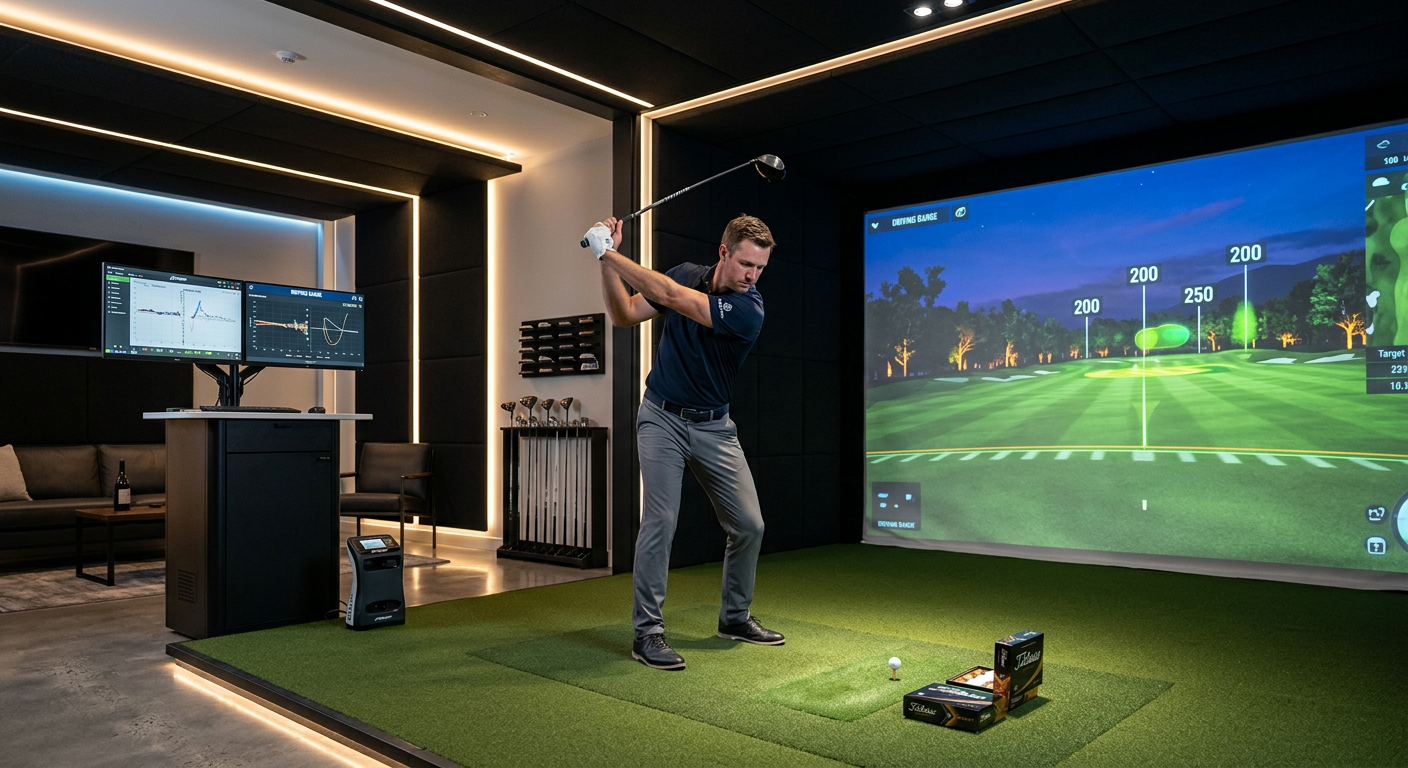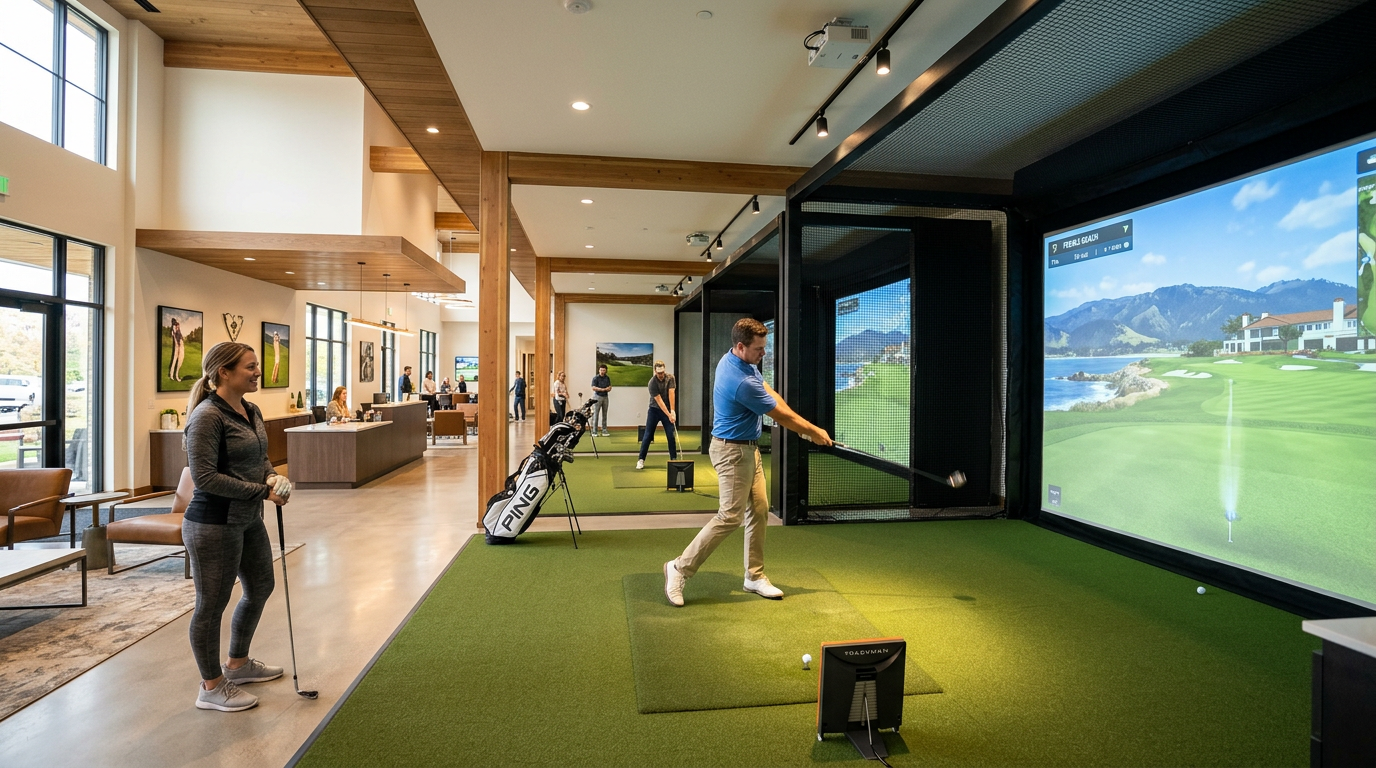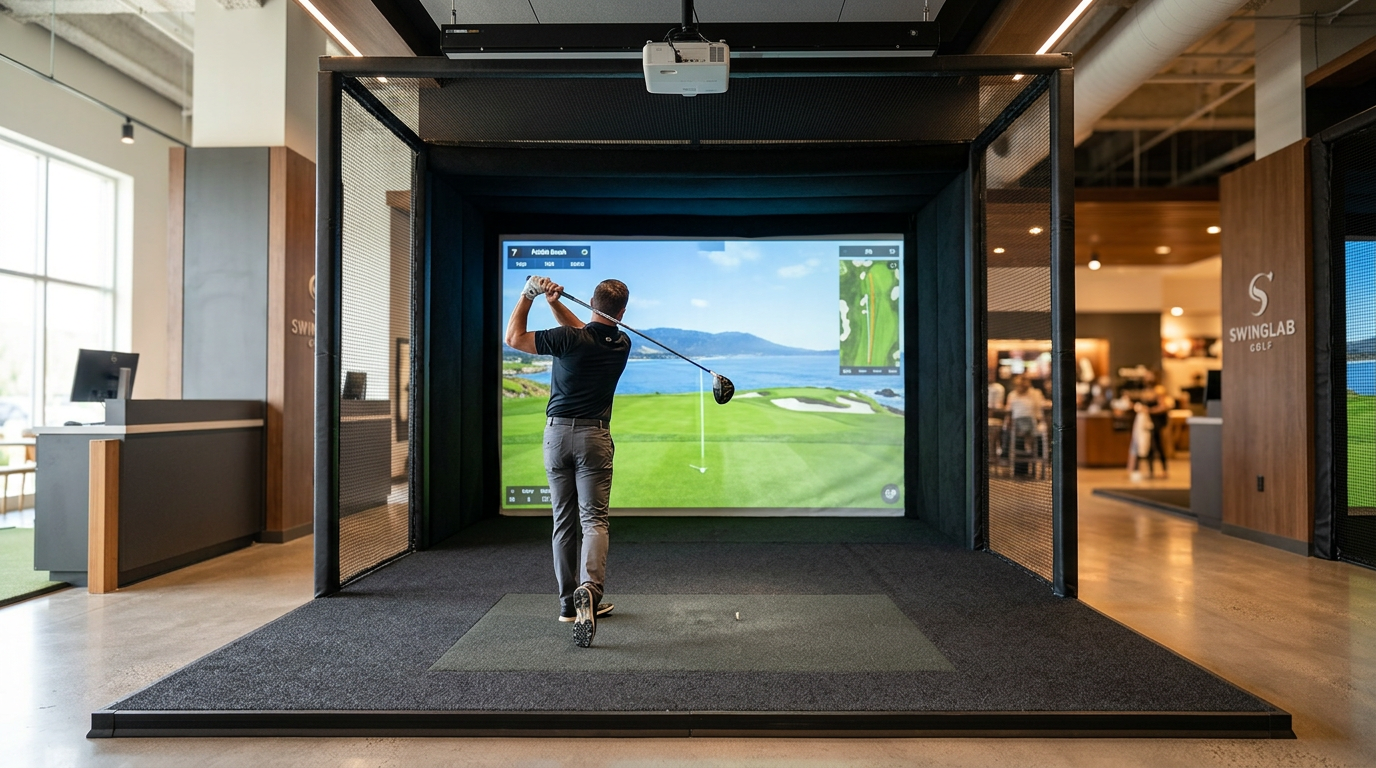
Setting up a golf simulator is the dream of many Forney golfers looking to shave strokes off their game without battling the Texas heat or unpredictable rain. However, before you invest thousands of dollars in tech, you must answer the most critical question: how much room do you need for a golf simulator?
To swing a driver comfortably and capture accurate data, a golf simulator requires a minimum room size of 10 feet high, 12 feet wide, and 18 feet deep. While you can technically fit a setup into smaller spaces, cramped dimensions often lead to restricted swings and inaccurate ball tracking.
At The Wedge in Forney, we built our facility specifically to exceed these requirements, ensuring that every golfer can swing freely. If you are debating between a home build and using a professional facility, understanding these spatial demands is the first step in your journey.
Minimum Ceiling Height for Golf Simulators
Ceiling height is the most common deal-breaker for home simulator enthusiasts. If your ceiling is too low, you will subconsciously shorten your follow-through or flatten your swing plane to avoid hitting the drywall with your driver. This phenomenon, often called indoor swing syndrome, can ruin the muscle memory you are trying to build.
Industry standards, such as those found in the Golf Digest guide to simulator design, suggest a minimum height of 9.5 feet, though 10 feet is the gold standard. A 10-foot ceiling allows a tall golfer with a vertical swing to use any club in the bag without hesitation. If you are considering a home setup, remember to account for the height of your hitting mat, which can add 1 to 2 inches to your effective floor height.
Required Room Width for Safe Swings
Width is about more than just the size of the impact screen. It is about safety and the ability to center your swing. For a single-user setup (either right-handed or left-handed), a width of 12 feet is generally sufficient. This allows enough room for the golfer to stand in the center and still have a buffer for the clubhead on the backswing and follow-through.
However, if you plan on hosting friends or are a left-handed golfer playing with right-handed partners, 15 feet of width is the preferred minimum. This extra space allows for a centered hitting strip where both types of golfers can play without moving the launch monitor or the mat. Providing ample width is a key reason why many players prefer our facility over home garages, as we have designed our bays to be spacious enough for all swing types. You can learn more about our high-end environment on our about us page.
Room Depth and TrackMan Accuracy
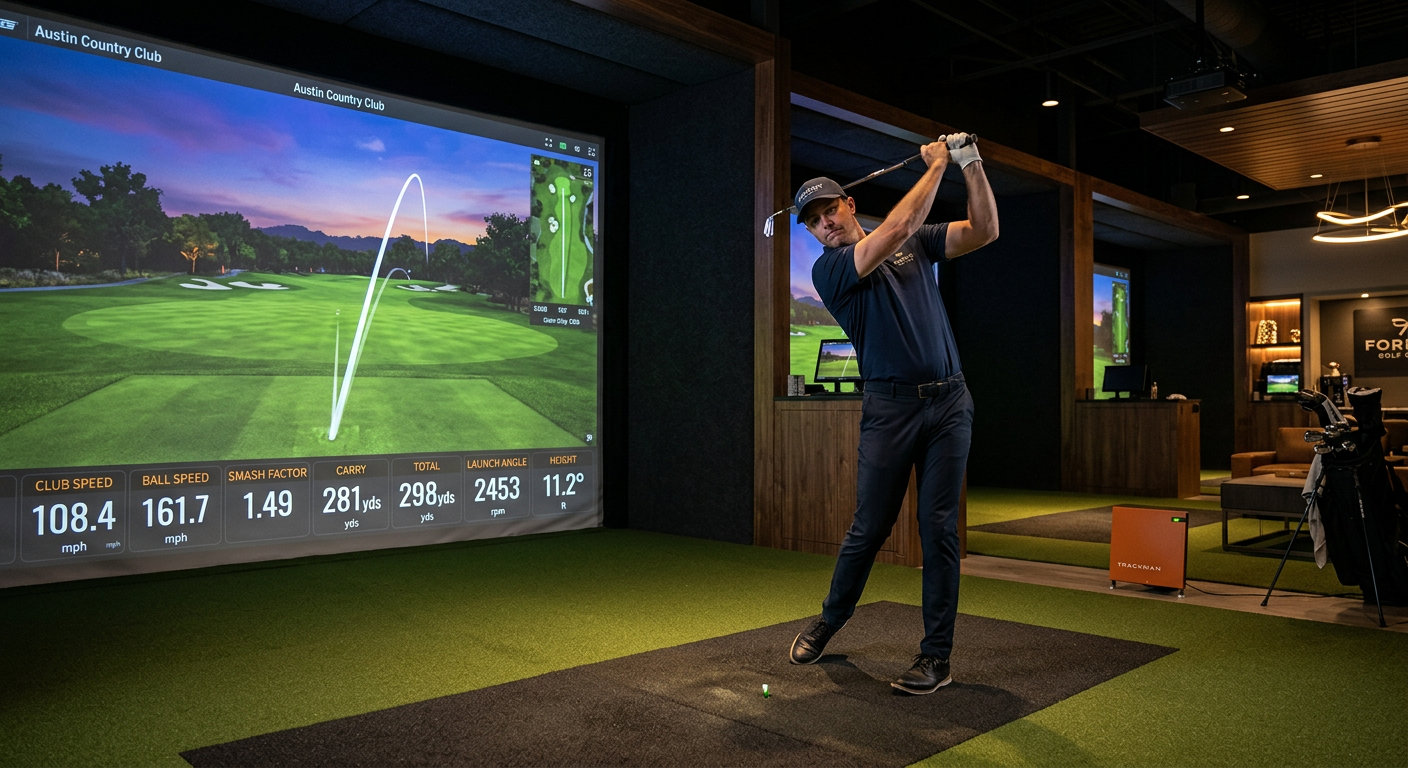
While height and width are about physical safety, room depth is about the physics of the technology. The Wedge utilizes TrackMan 4 technology, which is widely considered the gold standard in the industry. Because TrackMan uses Dual Radar Technology, it requires specific distances to "see" the ball and the club.
According to the official TrackMan Indoor Setup Guide, the radar unit itself needs 8 to 10 feet of space behind the golfer. Additionally, the ball needs at least 8 feet of flight time from the tee to the impact screen to allow the radar to accurately measure spin rate and launch angle. When you add the two together, along with a small buffer behind the screen to prevent the ball from hitting the back wall, you are looking at a total depth requirement of 18 to 25 feet.
If your room is too shallow, your launch monitor may struggle to provide the precision you need. For those curious about how these technical requirements translate to performance, our guide on how accurate are golf simulators explains the relationship between setup and data reliability.
The Risks of Cramped Simulator Spaces
Attempting to squeeze a high-end simulator into a standard 8-foot ceiling garage or a narrow spare bedroom often results in "swing compensation." This is where a golfer subconsciously alters their natural motion to accommodate the physical limits of the room. Over time, this can lead to:
1. Developing a flat swing plane to avoid the ceiling.
2. Shortening the follow-through, leading to deceleration at impact.
3. Anxiety during the swing that prevents full commitment to the shot.
If you don't have the luxury of a 20-foot deep room with 10-foot ceilings, you may find that a home setup does more harm than good to your handicap. In these cases, utilizing a professional facility designed around our technology ensures you are practicing with the same freedom you feel on the tee box at a local course.
Comparing Home Costs and Professional Facilities
The physical space is only one part of the equation. Once you have the room, the costs of high-speed cameras, impact screens, projectors, and the launch monitor itself can escalate quickly. Many golfers find that the initial investment for a pro-grade setup exceeds $20,000 when factoring in construction and tech.
If you are weighing the financial and spatial commitment, reading our breakdown on how much a golf simulator costs can help you decide if a home build or a membership at a specialized facility like The Wedge is the right move for your budget and your home's square footage.
Frequently Asked Questions About Simulator Space
Can I put a golf simulator in an 8-foot ceiling?
It is not recommended. Most golfers will hit an 8-foot ceiling with a wedge or a driver. This height is only viable for children or very short hitters using short irons, and even then, it is highly risky.
How much space does a TrackMan 4 need specifically?
TrackMan 4 requires a minimum of 16 feet from the radar to the screen (8 feet from radar to tee, and 8 feet from tee to screen). More distance is always better for spin accuracy.
Do I need a special room for a simulator in Forney?
Local residential construction in the Forney area often features 9-foot ceilings in modern homes, which is slightly under the ideal height. Many golfers utilize their garages, but you must ensure the garage door tracks do not interfere with your swing.
What is the ideal width for a simulator?
15 feet is the ideal width. This allows for a centered hitting area and plenty of room for both left and right-handed golfers to play in the same session comfortably.
Training Without Limits at The Wedge
If your home doesn’t have the 20-foot depth or 10-foot ceilings required for a world-class TrackMan setup, don't compromise your swing. At The Wedge in Forney, we have handled the space requirements, the calibration, and the technology for you. Our bays are designed to provide the ultimate environment for game improvement, free from the constraints of "indoor swing syndrome."
Ready to see what your real swing feels like in a pro-grade environment? **Visit The Wedge in Forney today** or contact us to learn more about our training programs and bay rentals.